Sunday, September 10, 2017

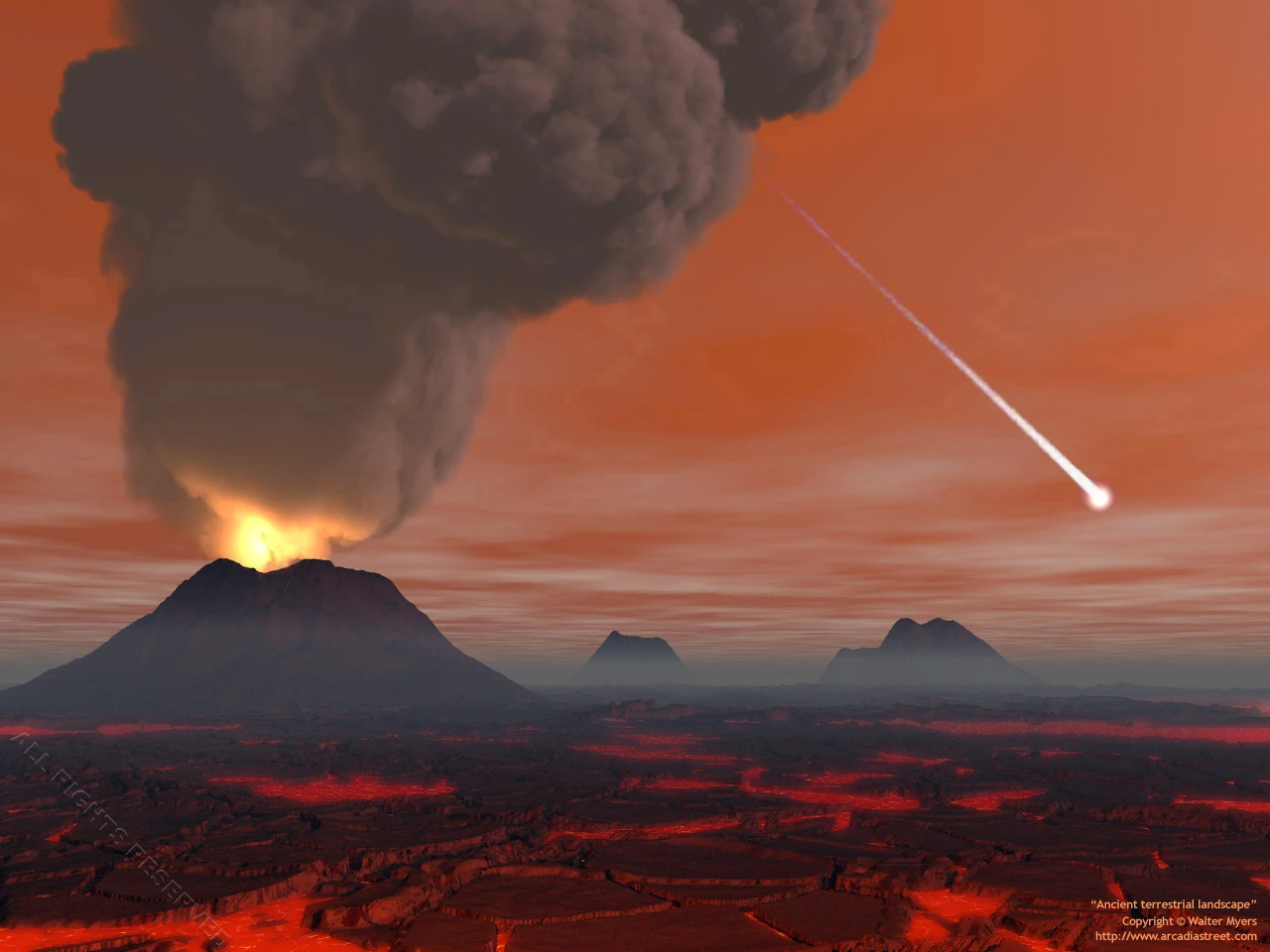
Weekly Blog 9/10/17: PreCabrian Era

http://vignette3.wikia.nocookie.net/walkingwith/images/b/b1/Earth_ancient_volcano_1280.jpg/revision/latest?cb=20141219140520

Summary

The Precambrian Era ranged from 544 million years ago to 4.6 billion years ago. It was a time of continent building for the earth. In addition to this, the first early stages of life also took place. During the Archean Time, the earth's crust was creating by the cooling of lava. Some lava escaped through cracks and those volcanoes help create more rock surface. The volcanoes created clouds which created rain which made the ocean. In the ocean, the first life was created, single celled bacteria. Thanks to the oxygen the organisms released into the air, life forms developed becoming more complex. In addition to this, the first plate tectonics were creating causing the first super continent called Rodinia. That took place 1.1 billion years ago. The ocean caused Rodinia to break up making the second super continent Pannotia.

SP6: Constructing explanations and designing solutions

I constructed explanations and designed solutions when I researched information and completed a data sheet on the Precambrian era. When I researched information on how the earth first formed as well as what it was like during that time, I explained and answered the questions on the data sheet and exercised the sixth science and engineering practice.


XCC: Stability and Change

The planet we call home is constantly changing from the species that inhabit it to the geologic structure of the earth itself. The Precambrian Era was a big time of change. When the earths crust was made, plate tectonics created the first super continent Rodinia. 350 million years later Rodinia broke up. North America moved towards the South pole while the rest of the continents moved up north. 150 million years later they collided again creating Pannotia. Now, the earth looks completely different. This shows that the earth is constantly changing and moving. However the process of change (how the plate tectonics move to create new land forms is still the same as it was millions of years ago.


Multiplier

This week I was a learning because I mainly focused on my own research. I read articles and passages to gather information and record it in my data sheet to use in the final project.





Sunday, September 3, 2017

Weekly Blog 9/3/17 The Rock Cycle

1. Sedimentary Rock           2. Metamorphic rock

 Summary

Geology is the study of the structure of planet earth and the forces that make and shape the earth. In geology, there is a law called the principle of uniformitarianism which is the idea that geologic processes that operate today also operated in the past. This principle helps geologists understand the world and explain the natural phenomenon by allowing them to look at how things are made now and know how things were made then. The rock cycle is the cycle that changes rocks into different kinds. There are three types of rocks: Igneous, sedimentary and metamorphic. 


S&EP 2: Developing and Using Models

This week I developed and used models when I created a model representing the rock cycle using starbursts. First sedimentary rock was created by cutting up two different colored starbursts and applying a light amount of pressure on them. The sedimentary rock was then transformed into metamorphic rock when more heat and pressure was applied. The metamorphic rock was then thrown into a microwave (volcano) and heated up and cooled into igneous rock. This model represents the rock cycle because it shows the process needed in order for each type of rock to change into another.


XCC: Patterns

As I mentioned earlier, the principle of uniformitarianism is the idea that what process is happening now also happen in other places around the world and will operate the same way in the future and past. This principle proves that geologic processes in the world repeat a pattern. By looking at the geologic pattern scientists can date rocks, understand the past, and predict the future.


Friday, August 25, 2017

Science and Engineering Practices Quiz Re-Grade

Question # 2: A group of 7th graders creates and analyzes graphs of the data from an investigation about the relationship between a ball's mass and its speed down a ramp.

My answer: Analyzing and Interpreting Data
Correct answer: Using mathematical and computational thinking

The answer I selected was analyzing and interpreting data. The reason why I thought the answer was analyzing and interpreting data was because the group of 7th graders were analyzing graphs of data. However, I didn't take into account how they were investigating and analyzing the relationship between mass and speed with takes mathematical and computational thinking. Due to how the 7th graders were using mathematical thinking to analyze a graph on the relationship between a ball's mass and speed down a ramp, the correct answer is SP5: Using mathematical and Computational thinking. 


Question #5: Students in Mrs. Garcia's class use a class chart of what different animals eat and group the animals in different ways based on their food sources. Students then discuss which animals would be affected if changes occurred to different food sources.

My answer: Using mathematical and computational thinking
Correct answer: Analyzing and Interpreting Data

The answer I selected was using mathematical and computational thinking. I mixed it up with analyzing and interpreting data which was the correct answer. The students did not use much mathematical and computational thinking. Analyzing and interpreting data is the correct answer due to how the students used and studied charts of what animals eat to understand the way the data works (predict which animals would be affected if certain events happened).
 

Monday, August 21, 2017

Why I Returned to AdVenture

     AdVenture, a school full of projects, teamwork, different people, and technology. My name is Enya Do and I have been going to the AdVenture ATEM program since the 5th grade. I returned to Adventure for my eighth-grade year for several reasons: I like the way we learn in AdVenture, I already know all of my teachers and peers, and my brother is transferring this year. Let me go into more depth about all of that.

     Reason number 1: I like the project based learning curriculum that AdVenture has adopted. Learning through real world situation based projects as well as practicing team is important to me. Since the 5th grade, AdVenture has been setting me up for success in the future by teaching me social skills. Reason number 2: I feel like it would be too hard as well as unreasonable to transfer into a new school in my last year of middle school. I already know all my friends, teachers, as well as the way this school works. For example, I have been in Ms. Garcia's class for four straight years. Reason number 3: This year my brother will go through his first year in AdVenture as a fifth grader. It is more convenient for my parents to pick both of us up at the same time and location. In addition to this, I can also help him out if he doesn't understand anything.

     AdVenture is a great school for kids that prefer project based and hands on learning like me. That being said, I am proud to return and be apart of the AdVenture STEM program for my last year of middle school.


Sunday, May 21, 2017

Article Blog 5/21/17 - Stars

https://upload.wikimedia.org/wikipedia/commons/6/62/Starsinthesky.jpg

Summary

When huge clouds of dust and gas get so big they start to cave in, the center heats up and becomes a core that will one day become a star. Stars come in all different shapes, sizes, and colors. The larger the star, the quicker it will burn out. Most stars live for billions of years. When giant stars die, a huge explosion called a supernova is created. If the supernova is big enough, a black hole can be created. 


Citation

"How Do Stars Form and Evolve?" Newsela | How Do Stars Form and Evolve? N.p., n.d. Web. 22 May 2017.


SP4: Analyzing and interpreting data

The author of this article analyzed and interpreted data to learn more about stars and write an informational article communicating what he or she learned. In order to find out all of this information, he or she had to read, watch, and talk to experts about stars, supernovas, black holes, and more. 


Saturday, May 13, 2017

Weekly Blog 5/13/17 - The Environmental Accords

https://sites.google.com/site/earthsciencehumanimpact/_/rsrc/1472778978660/home/Human%20Impact%202.jpg

Summary

Humans impact the earth in many different ways both negative and positive. However, most of it is negative. Things like clearcutting, overfishing, polluting the air and more are happening. The Urban Environmental Accords is a document with a list of goals that will get us to an "ecologically sustainable, economically dynamic, and socially equitable" future, as stated by sfenviornment.org. There are 21 "actions" or goals in the environmental accords all under 7 categories. The categories include energy, waste reduction, urban design, urban nature, transportation, environmental health, and water. The environmental accords are important because they protect the earth and make it more sustainable for the future. 


SP6: Constructing Explanations and Designing Solutions

I constructed explanations when I rephrased and summarized parts of the Urban Environmental Accords to better understand what they were saying. I explained and discussed the meaning of the accords with a partner. I thought of solutions to problems while playing legends of learning. Some puzzle games required thinking about the solution to get to the next level.


XCC: Cause and Effect

Everything happens because of cause and effect. For example, if we plant more trees around a sidewalk, there will be more shade on the sidewalk, this will make the air cooler not only preventing things like global warming but saving energy. Since the air is cooler, fewer people will use their A/C and fans. Simply making more shade outside (the cause) has many positive effects. Creating more shade is once of the environmental accords. 

Sunday, May 7, 2017

Article Blog 5/7/17 - Stone Age dentists treated cavities with tar

https://upload.wikimedia.org/wikipedia/commons/thumb/c/ce/Blausen_0864_ToothDecay.svg/2000px-Blausen_0864_ToothDecay.svg.png

Summary

Long before dentists existed, during the stone age, humans cleaned their cavities differently. They used sharp stones to scrape and chip out their decayed teeth and coated the damaged tooth with bitumen, a tarry type of crude oil. They also used toothpicks (pieces of sticks). About 20 years ago in a site in Italy called Riparo Fredian, some researchers excavated six teeth human teeth. The teeth were found to have scratch marks in the decayed part and after a chemical and microscopic analysis of the teeth, the researchers found out the dark parts of the cavity walls were actually bitumen as well as plant fibers and some hairs. Benazzai, a researcher believes that by coating the teeth with bitumen, it protected the teeth from further infection.


Citation

Bower, Bruce. "Stone Age Dentists Treated Cavities with Tar." Science News for Students. Science for Students, 05 May 2017. Web. 07 May 2017. <https://www.sciencenewsforstudents.org/article/stone-age-dentists-treated-cavities-tar>.


SP4: Analyzing and interpreting data

The author of this article, Bruce Bower, analyzed and interpreted data to learn more about this topic and write an article communicating what he learned. In order to find out all of this information on studies and what other scientists and researchers have learned about old dentistry, Bower had to do lots of research and analyze what information he found to verify its credibility.