Sunday, October 15, 2017

Weekly Blog 10/15/17 - Evidence for Evolution

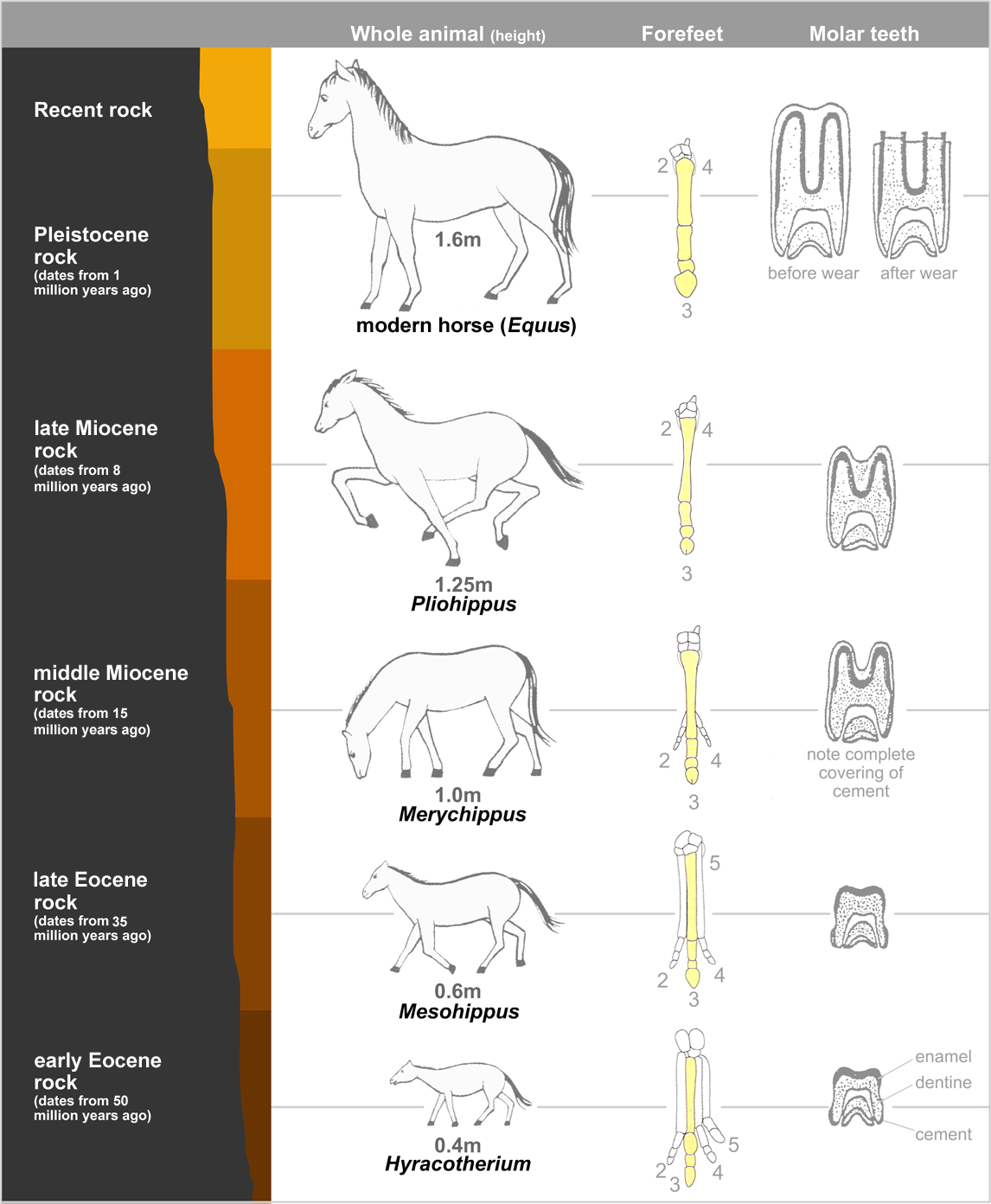
https://upload.wikimedia.org/wikipedia/commons/d/dd/Horseevolution.png

Summary

There is a lot of evidence for evolution including the fossil record. The fossil record is the history of life documented by fossils. When looking at the fossil record, you can compare different fossils to other fossils that look similar and slightly different to one another. By examining the rock you found the fossil in, you can also get an estimated time and duration of that species life. Once you have found enough fossils of animals that look extremely similar, you can place them in an order that makes sense and see how the particular organism evolved over time. More evidence of evolution can be found in comparative anatomy. For example, when you look at the bones in the arm of a human, bird, dog, and whale, you will see that all of those organisms have a very similar bone structure. This tells us that all of those species are related therefore evolution has occurred.


SP2: Developing and Using Models

I developed a model when I created a poster with my group containing the fossil record for the "adventurian" species. The table included the duration and time that the species lived as well as a picture of what the species looked like. You can use this model as a visual representation of how the species evolved over the years by looking at the pictures of the species and noticing the small changes that appeared. The purpose of this model was to explain how fossil records can be used as evidence for evolution.


XCC: Stability and Change

In evolution, organisms always change and evolve through generations. In our fossil record of the "Adventurian" species, I noticed how in the beginning or first few eras the species didn't really evolve. This must mean that the environment of the species was stable. However, after that, the species started to change a lot. It evolved by growing spikes, legs, changing shape, size, and more. in nature, though it may seem stable organisms are always changing.


Saturday, October 7, 2017

Weekly Blog 10/7/17 - Natural Selection

https://c1.staticflickr.com/4/3698/13578828153_ff58f590b4_b.jpg

Summary

     Natural selection is the process in which animals more adapted to the environment are more likely to survive and reproduce. For example, when Darwin studies the same species of finches located on the different island of the Galapagos he noticed that all of them were slightly different. Each of the finches had certain variations of color, beak or claw shape, size, etc.) depending on what adaptations helped them survive long enough to reproduce in their particular environment. Darwin learned that this was due to natural selection. Let us say in this environment there are a lot of little bugs for the finches to eat. If one finch with a fat beak had 4 finch babies one of which was born with a long skinny beak. The finch with a long skinny beak would be more likely to survive because it can more easily consume the small insects. That finch would have kids who would survive to have kids and over time the finches would all be better adapted to their environment. That is why all of the finches on each island were different. They all adapted to their own environment.


SP6: Constructing Explanations and Designing Solutions 

     I constructed explanations after I read passages and played games to explain the mechanics of natural selection. While playing the games, I evaluated the information given to me by the game. With that information, I was able to design solutions to the problems given to me and understand how exactly natural selection works. I did this with two topics: peppered moths, and Darwin's findings.


XCC: Stability and Change

     In the peppered moth's forest ecosystem, originally the system was stable. There were lots of white moths and a few black moths. However, when the Industrial Revolution took place, pollution turned the trees black causing change within the before stable system. The black moths were now better adapted to the environment. Through natural selection, the white moths were eaten and the black moths reproduced changing the ratio of black moths to white. Over time and generations, the system would stabilize. There are now only a few with moths in the once all-white system. If the trees turned white again, the system would once again change.
     

Sunday, October 1, 2017

Weekly Blog 10/1 - Evolution

https://upload.wikimedia.org/wikipedia/commons/thumb/8/80/Selection.svg/2000px-Selection.svg.png

Summary

The theory of evolution explains how all of the earth's species came to exist and that all living things share a common ancestor. It is any change in the heritable traits within a population across generations. In order for evolution to occur, reproduction is needed since an individual can't a evolve (a population with reproduction can). Evolution can occur five different ways. There can be the shrinking of a population, mating, mutations (a change in n organisms DNA), genetic drift (gradual loss of certain genes), and natural selection (only the best adapted to the environment survive). Out of all 5 of these types of evolution, however, only natural selection can cause adaptations to occur.   


SP 3 - Planning and Carrying Out Investigations

I planned and carried out investigations when I worked on two evolutions labs on mutations and genetic drift. The purpose of the experiments was to understand how mutation and genetic drift occurs and works in real life. While experimenting I collected data which helped me answer questions about how evolution occurs. 


XCC: Cause and Effect

The earth's and its organisms are always evolving whether it is visible to you or not. The cause of this change might have to do with the organism's environment. For example, think of a farmer. The farmer might use pesticides for their crops. However, he starts to notice that the pesticides aren't doing their jobs. What happened? because of the pesticides, the bugs weren't able to access their food. This caused their bodies to evolve and become immune to that pesticide. This story shows us that evolution may occur because of cause and effect.


Wednesday, September 20, 2017

WAC - Is it more important to Reduce, Reuse, or Recycle?


     According to KQED's the Math of Trash video,“Yearly America makes 160 million tons [of trash]”, (0:15). That's where the phrase reduce, reuse, and recycle comes in. It's a common phrase that we have all heard at some point in our lives. Annually, 22 billion pounds of Co2 is emitted into the air from garbage trucks alone. This causes climate change and pollution. But does recycling, reducing, and reusing really benefit the environment? And most importantly, which of the three is most important to do? It is more important to reduce than reuse and recycle. This is because reducing takes care of the root of the problem whereas recycling isn't efficient or cost effective and reusing items can become hazardous to your health. Let us elaborate on that.


     The root of our environmental dilemma can be addressed with reducing. After all, "The most essential way to reduce waste is to avoid creating it in the first place."(para. 2), wrote Bethany Wieman in her article What is Reduce, Reuse, and Recycle? In another article, Is it more important to You to Reduce, Reuse, or Recycle?, written by Trent Bateman and others, the article states that, “Conservationists argue that we cannot maintain our quality of life as human beings with as much waste as we produce, and that embracing sustainability is the best way to maintain modern culture"(para. 2). In other words, this means that the "best way to maintain modern culture" is by reducing. Reducing the amount of waste we produce and products we use would be the most efficient way to save our environment. The problem is that the amount of waste America produces is ridiculously high. Cutting back on how much we use will lead to a decrease in the trash we produce. In addition to this, reducing also preserves our resources. It saves our energy, plastic, paper, and more. In closing, reducing is a great way to address the root cause of problem and decrease the amount of trash in landfills.


     Sure reducing is a great solution, but what's wrong with recycling? Putting paper your plastics and more in that blue bin for it to be recycled into something new seems like a great idea. However, recycling isn't exactly what it is made out to be. For example, when it comes to single stream recycling (when all kinds of recycled items are mixed together in a collection truck), "about 25% of items in those streams end up going to landfills anyway"(para. 5), wrote Bateman and others in their article Is it More Important to You to Reduce, Reuse, or Recycle. Thus, meaning that recycling isn't really helping the environment as much as it should be. Furthermore, if the recycled items end up in landfills, the money being put into recycling is lost. That's not it though, the authors also stated, “The cost of recycling rises and the benefits decrease as cities transition from recycling just paper and metals to the practice of recycling plastic, food waste, and glass as well" (para. 5). In conclusion, recycling should not be a priority over reducing when it comes to helping out mother nature.


     Now that recycling has been discussed, let us review why reusing isn't exactly the best solution either. “Continuous use of some plastic bottles can lead to health risks if they are made with cheap plastic or if harsh chemicals leach out of those containers with increased use.”(para. 4), says Bateman and others once again in their article Is it More Important to You to Reduce, Reuse, or Recycle. This doesn't only apply to plastic bottles. If you reuse any poorly made item for too long, you are putting yourself at risk. Another example of this is if you are driving an old car. You may think that you are helping out the environment by continuing to use your old car rather than buying a new one but in reality, you aren't. Older car models are typically much less environmentally friendly. They use more gas and pollute the air with their old technology. All in all, reducing is still the best of the three solutions. 


     As I have shown, reducing is is the easiest, most efficient, and overall best method to prioritize of the three R's. Recycling is expensive and sometimes ends up leaving more trash in landfills and reusing can be unsafe. The next time that you brush your teeth or even leave a room will you turn off the tap? or turn off the lights? Hopefully you will. Just remember, the first step to creating a healthy environment is to reduce. 


Sunday, September 17, 2017

Our Interactive Tri-fold of the Geologic Time Scale

Summary

Throughout earth's history, so many things have occurred. Continents were formed and broken apart, species were created and wiped out, and humans have appeared bringing along with them, technology and more. The history of the earth is organized in a table which can be divided into eons, eras, and periods in order from largest to smallest. The earth itself is approximately 4.5 billion years old. There are four eras, the Precambrian, Paleozoic, Mesozoic, and Cenozoic. All of these eras are divided into several periods each of which has different major events. Currently, we are in the Cenozoic era. 

Backwards Looking

What problems did you encounter while you were working on this piece? How did you solve them?

One problem that came up while working on the geological timescale project was a conflict between some group members. While brainstorming ideas for the project, one group members started to feel excluded and that all of her ideas were being shot down. I solved this problem by explaining to her that the reason that we aren't going with any of her ideas was that of a time restraint. We wouldn't have enough time to execute her ideas well before presentation time and wanted to make sure our plan was realistic. After explaining this to her she felt better and the conflict was resolved. 

Inwards Looking

What was especially satisfying to you about either the process or the finished product?

For me,  was especially pleased with the finished product. I felt that it was organized, informative, and creative. My favorite thing about this project was the addition of the pop-up flaps. I feel like the flaps added a lot o the project because of their creativeness. In the future when making tri-fold type things, I will keep in mind the idea to add in pop-up information flaps. 

Outwards Looking

Did you do your work the way other people did theirs? In what ways did you do it differently? In what ways was your work or process similar?

My group was one of the only groups that created a tri-fold. Most groups made their project on a flat foam board. However, some groups created 3d models of things like rooms and bookshelves. In addition to this, while most groups printed out their information, my group handwrote everything down. On way our final product was similar was the information. Since most groups got their information from similar sources, the information turned out the same. Our work process was also the same with most of the groups. First, we researched, planned out our flaps, then began making them.

Forward-Looking

What's one goal you would like to set for yourself for next time?

One goal I would like to set for myself next time is to manage my time more efficiently and plan out when I am going to spend time on the project to get to get it done on time. I ended up staying up later than usual one night to get the project done. This was because I didn't realize how long it would take to create all of the information flaps.


Sunday, September 10, 2017

Weekly Blog 9/10/17: PreCabrian Era

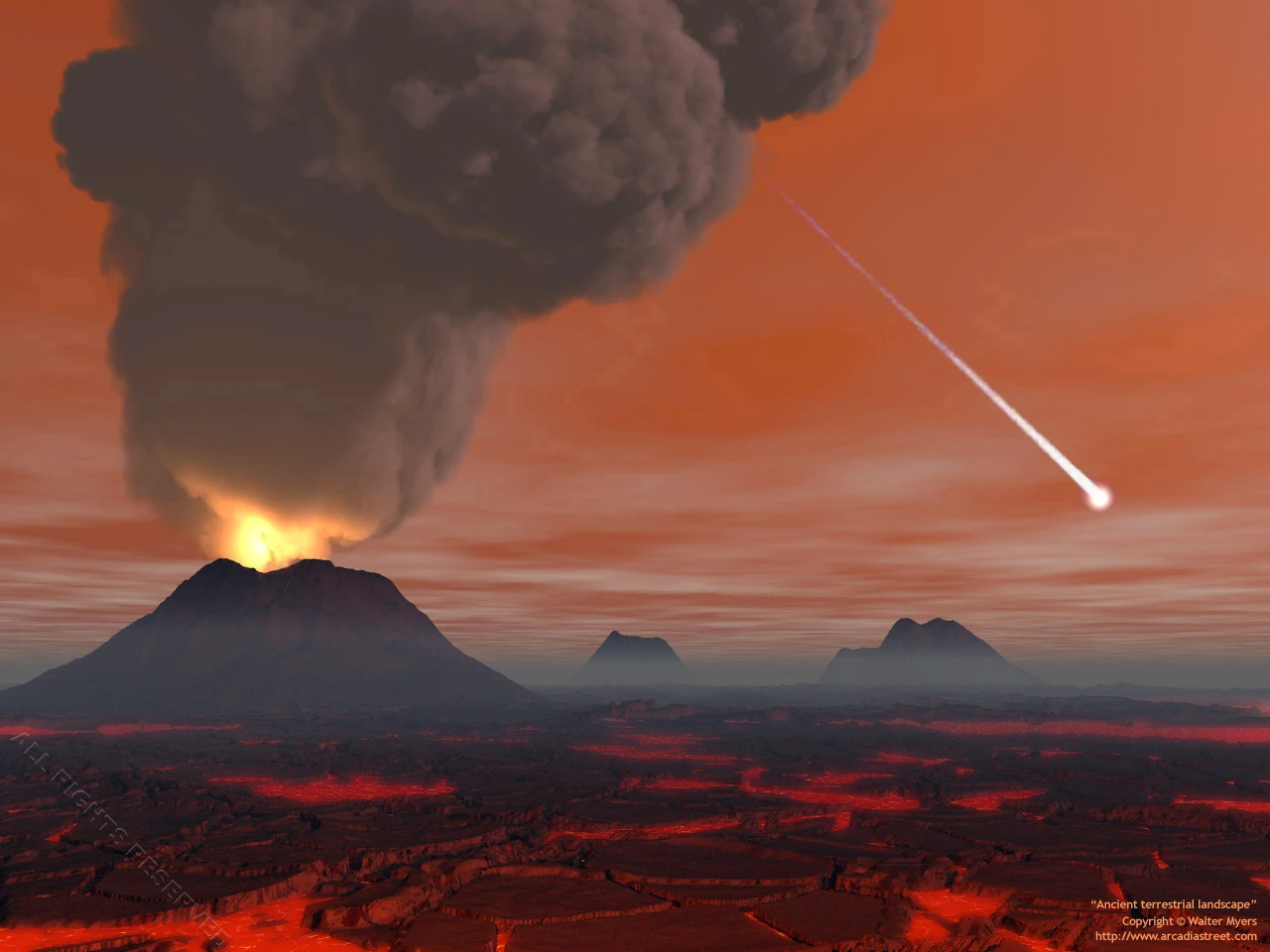
http://vignette3.wikia.nocookie.net/walkingwith/images/b/b1/Earth_ancient_volcano_1280.jpg/revision/latest?cb=20141219140520

Summary

The Precambrian Era ranged from 544 million years ago to 4.6 billion years ago. It was a time of continent building for the earth. In addition to this, the first early stages of life also took place. During the Archean Time, the earth's crust was creating by the cooling of lava. Some lava escaped through cracks and those volcanoes help create more rock surface. The volcanoes created clouds which created rain which made the ocean. In the ocean, the first life was created, single celled bacteria. Thanks to the oxygen the organisms released into the air, life forms developed becoming more complex. In addition to this, the first plate tectonics were creating causing the first super continent called Rodinia. That took place 1.1 billion years ago. The ocean caused Rodinia to break up making the second super continent Pannotia.

SP6: Constructing explanations and designing solutions

I constructed explanations and designed solutions when I researched information and completed a data sheet on the Precambrian era. When I researched information on how the earth first formed as well as what it was like during that time, I explained and answered the questions on the data sheet and exercised the sixth science and engineering practice.


XCC: Stability and Change

The planet we call home is constantly changing from the species that inhabit it to the geologic structure of the earth itself. The Precambrian Era was a big time of change. When the earths crust was made, plate tectonics created the first super continent Rodinia. 350 million years later Rodinia broke up. North America moved towards the South pole while the rest of the continents moved up north. 150 million years later they collided again creating Pannotia. Now, the earth looks completely different. This shows that the earth is constantly changing and moving. However the process of change (how the plate tectonics move to create new land forms is still the same as it was millions of years ago.


Multiplier

This week I was a learning because I mainly focused on my own research. I read articles and passages to gather information and record it in my data sheet to use in the final project.


Sunday, September 3, 2017

Weekly Blog 9/3/17 The Rock Cycle

1. Sedimentary Rock           2. Metamorphic rock

 Summary

Geology is the study of the structure of planet earth and the forces that make and shape the earth. In geology, there is a law called the principle of uniformitarianism which is the idea that geologic processes that operate today also operated in the past. This principle helps geologists understand the world and explain the natural phenomenon by allowing them to look at how things are made now and know how things were made then. The rock cycle is the cycle that changes rocks into different kinds. There are three types of rocks: Igneous, sedimentary and metamorphic. 


S&EP 2: Developing and Using Models

This week I developed and used models when I created a model representing the rock cycle using starbursts. First sedimentary rock was created by cutting up two different colored starbursts and applying a light amount of pressure on them. The sedimentary rock was then transformed into metamorphic rock when more heat and pressure was applied. The metamorphic rock was then thrown into a microwave (volcano) and heated up and cooled into igneous rock. This model represents the rock cycle because it shows the process needed in order for each type of rock to change into another.


XCC: Patterns

As I mentioned earlier, the principle of uniformitarianism is the idea that what process is happening now also happen in other places around the world and will operate the same way in the future and past. This principle proves that geologic processes in the world repeat a pattern. By looking at the geologic pattern scientists can date rocks, understand the past, and predict the future.