Thursday, November 16, 2017

Project Blog 11/16/17 - Fluxx Cards


Summary

This past week we were tasked with the project of creating a deck of fluxx cards that taught a certain science concept. The deck of cards had to include keepers, goals, actions, creepers, and rule cards. My teammate and I chose our topic to be symbiosis. Symbiosis can be defined as interactions between organisms. There are three forms of symbiosis: parasitism, commensalism, and mutualism. Parasitism is when one organism benefits while the other is harmed. Commensalism is when one organism is benefited while the other is neither harmed nor benefited. One example that we used as a goal in our fluxx card deck is the relationship between the phainopepla bird and saguaro cactus. Since the bird builds its nest in the cactus, the bird gets a home and the cactus isn't affected. Finally, the last type of symbiosis is Mutualism. Mutualism occurs when both organisms are benefited.

Backwards Looking - What problems did you encounter while you were working on this piece? How did you solve them?

After printing out our cards, we realized that the backs and front of the cards were not lined up correctly. In order to solve this problem, we decided to just cut the cards normally while holding the side with all of the information. By doing this, we would be cutting off and cropping parts of the card back but keeping the important information on the inside of the cards. After doing this, we realized the backs of the cards haven't consisted however the important part was still intact and unaffected.

Inwards Looking - How do you feel about this piece of work? What parts of it do you particularly like? Dislike? Why? What did/do you enjoy about this piece or work?

One thing I particularly liked about these cards was the design aspect of them. On each type of card, we changed the font and picture for the sidebar of the card to match our topic. I think this tied everything together very nicely. One thing I didn't like, however, was how the back side of the cards was cropped of due to how we didn't line up the backs to the front while printing.

Outward Looking - Did you do your work the way other people did theirs? In what ways did you do it differently? In what ways was your work or process similar?

Unlike other groups, my partner and I was the only group that drew in the pictures for the goal and keeper cards. This along with how we changed the fonts of our cards was the main major difference. Somethings we did similar in our work was how for other groups the fronts and backs also weren't lined up. I noticed that lining up the sides was a struggle for many groups.


Sunday, November 5, 2017

Designer Species Project Blog 11/5/17

Summary

In order to surviv, organisms have to have certain characteristics and adaptations. These can include camouflaging coats of fur, certain body shapes, and much more. For example, to stay cool inside a hot burning desert, fennec foxes have giant ears. They provide more body surface for the fox's body heat to radiate around. The fur of sloths is able to suck up moisture and grow algae to help them camouflage. The gornopoulos, a mammal that lives in humid tropical rainforests has both of these characteristics as well as a flying squirrel body and sticky feet pads. Like all organisms, the gornopoulos has many specials ways that it survives to reproduce. It eats nuts, fruits, and insects. The large ears also serve another purpose. It gives the gornopoulos great hearing which allows it to hear predators and prey to know where they are. In conclusion, animals need certain adaptations and abilities to reproduce.

Backwards Looking - 

What process did you go through to produce this piece?

In order to produce our poster and presentation, we first had to research about what type of traits our animal would need to survive on its planet. The next step was to begin creating our species and answering the questions about our organism. Once we were completely sure about our idea, we began to make our model. For our model, we created a diagram (shown above). The final step was to make our presentation and script. Once that was completed all we had to do was practice.

Inwards Looking -

What were your standards for this piece of work? Did you meet your standards?

For this project, my standards were high. I felt that I had a good group and that there wasn't a reason for me to not do a great job. After presenting, I felt that I did meet my standards. My group was able to create a great poster that not only looked organized but was also informational. Our presentation was okay overall but I felt like with more practice we could have definitely improved.

Outwards Looking -

Did you do your work the way other people did theirs? In what ways did you do it differently? In what ways was your work or process similar?

Unlike other groups, my group decided to create a skit for our presentation. We were the only ones that did this. The reason why we wanted to do a skit was that we wanted to present our information in an interesting and entertaining way. However, like most groups, we created a poster for our model rather than making a 3d version of our organism. 

Forwards Looking -

One thing I would like to improve upon is...

One thing that I would have liked to improve upon was our presentation. Since we wrote the script eh day before, we weren't entirely comfortable with our lines. Since we used no script, some of us forgot their lines. In addition to this, we definitely could have added more to the performance. In the future, I can solve this problem by thinking ahead and making sure the script gets done early enough to allow our group to practice how we want to present.

Sunday, October 29, 2017

Weekly Blog 10/29/17 - Animal Adaptations

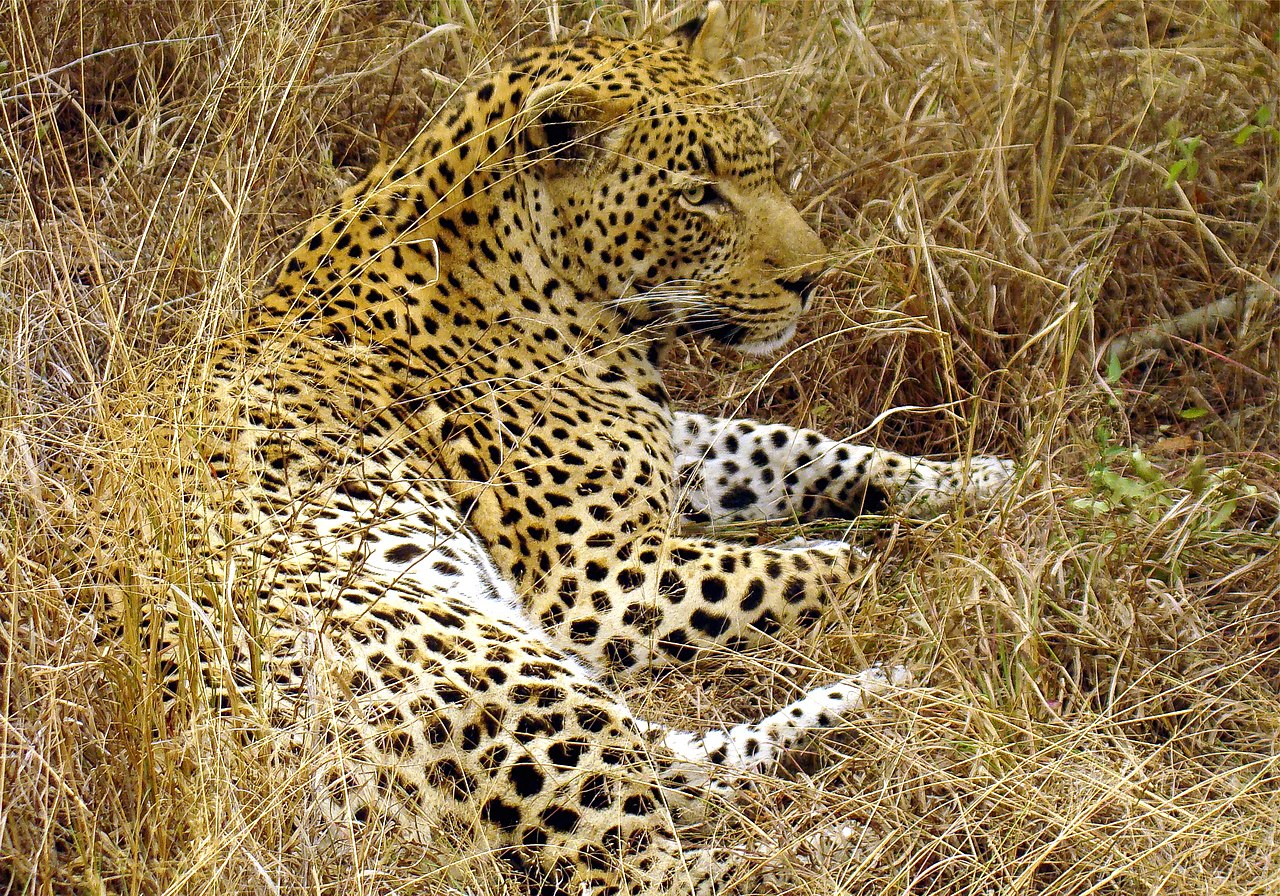
https://upload.wikimedia.org/wikipedia/commons/thumb/7/7a/Great_male_Leopard_in_South_Afrika-JD.JPG/1280px-Great_male_Leopard_in_South_Afrika-JD.JPG

Summary

In order for organisms to reproduce, they adopt certain traits and characteristics they help them survive in their habitats. These can include a striped coat for camouflage from predators or maybe a long, thin beak that allows them to collect pollen. The fennec fox, for example has giant ears that help keep them cool. The ears provide more surface area for the fox to spread it's body heat around. In addition to this, the fennec fox has thick sandy colored fur. The fur serves many purposes. It reflects heat, keeps the fox warm during cold nights and grows on the paws of their feet to prevent their feet from getting burned by hot desert sand. When a new species is created, they have to be able to survive by having certain adaptations.


SP2 Developing and Using Models

I developed models this week when I started to map out and draw my groups designer species. My group first brainstormed ideas. Then we drew a rough sketch of our first model that included all of the characteristics we wanted in our organism. Finally, we began to finalize our ideas which we wrapped up with an official drawing of our species. At the end of the week, we began to bring in materials that we could use to actually create our 3D model. It was important for us to develop and create our drawing models so we could visualize what we wanted our designer species to look like.


XCC: Structure and Function

Many animals and plants have certain body structures that carry out perform certain functions. For example, think of a giraffe. The structure of a giraffe includes a yellow coat of fur with brown spots. They also have an iconic long neck. All of these things serve a purpose. The "function" of the brown spots is to allow the giraffe to camouflage from a far distance. The dark and light spots mimic the shadows that is produced through leaves in a tree. The "function" of the long neck structure is to allow the giraffe to reach food high up in the trees. Again, all organisms have a structure and function in the adaptations and body.


Sunday, October 22, 2017

Weekly Blog 10/22/17 - Animal Classification

https://upload.wikimedia.org/wikipedia/commons/thumb/2/28/Cladogram_of_Cetacea_within_Artiodactyla.png/320px-Cladogram_of_Cetacea_within_Artiodactyla.png

Summary

To keep track of the evolutionary relationships between organisms, organisms are classified into groups inside groups inside of groups starting with their kingdom. Organisms can be classified into the 5 following kingdoms: Animals, plants, fungi, bacteria, and protists. Once they have been classified into their kingdoms, they are grouped into their phylum and organized by their main features. In the animal kingdom, for example, there are 40 different phyla.  After that, organisms are organized into classes, orders, families, genus, and species. Whenever you hear the scientific or binomial name of a species, the first word would be their genus while the second word is their species. For example, the binomial name for humans is homo sapiens. Homo is the genus and sapiens the species. To organize all of this scientists use something called a cladogram (a branching off diagram like shown above). 


SP2 Developing and Using Models

I developed models when I completed worksheets by organizing my data into cladograms and data tables. When figuring out the t-rex's closest relative, I first created a table or model that listed out which organisms had or didn't have the traits. Once the data table was completed, I followed the online interactive and created a digital cladogram model. I used the model to find the closest relative to the t-rex. I did this by seeing which species shared the most traits with the t-rex as well as looking at the common ancestors. 


XCC: Patterns

In cladograms, all of the species are organized in a pattern. At the bottom of the cladogram, there are species that share only a few traits with the other species and are not as closely related. At the top of the cladogram, you will find the species that have all of the traits. Cladograms are organized in a pattern and order of common ancestry. They can also help us understand the patterns of evolution. We can look at cladograms to see the order of how species changed and to find patterns in evolution.


Sunday, October 15, 2017

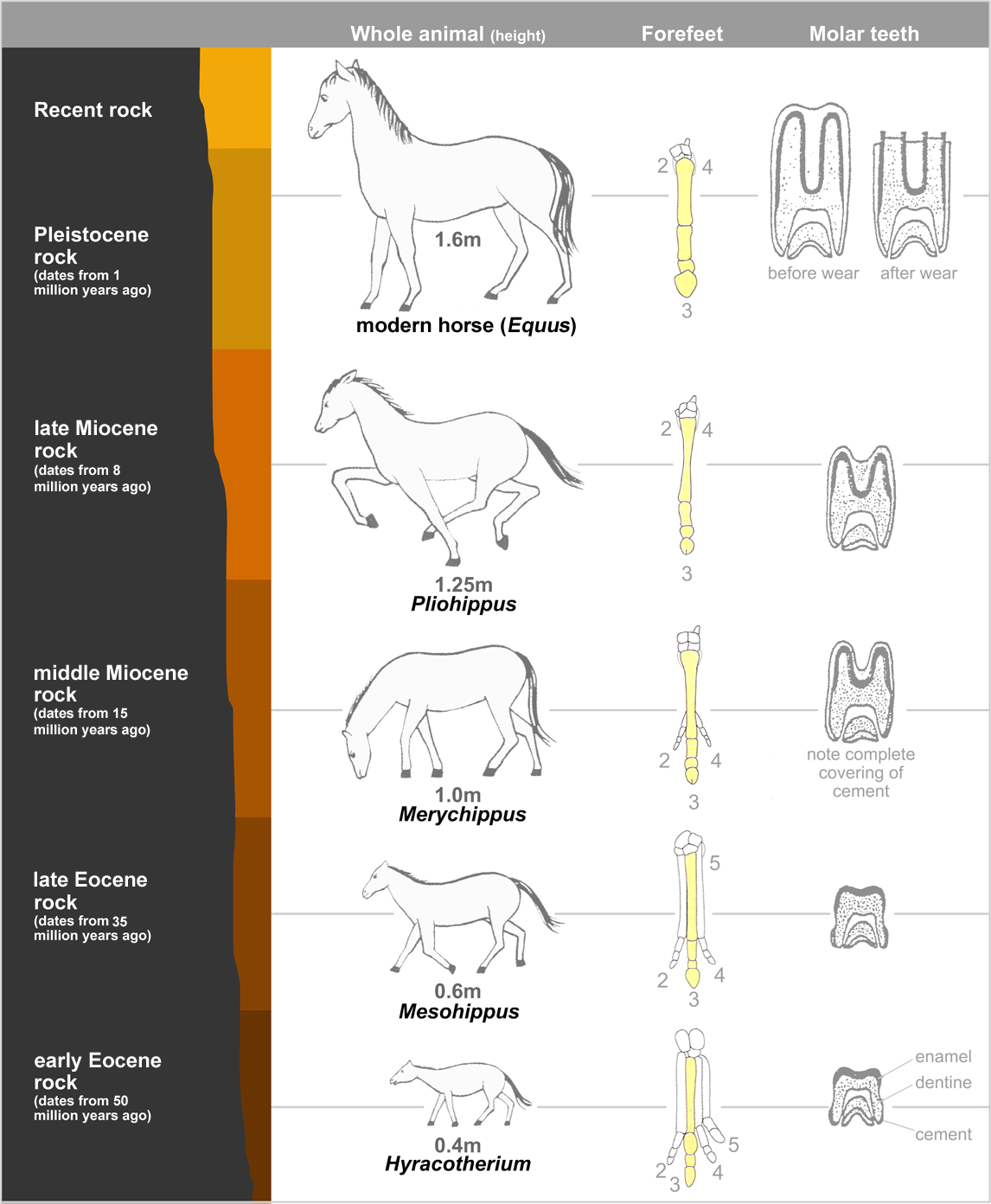
Weekly Blog 10/15/17 - Evidence for Evolution

https://upload.wikimedia.org/wikipedia/commons/d/dd/Horseevolution.png

Summary

There is a lot of evidence for evolution including the fossil record. The fossil record is the history of life documented by fossils. When looking at the fossil record, you can compare different fossils to other fossils that look similar and slightly different to one another. By examining the rock you found the fossil in, you can also get an estimated time and duration of that species life. Once you have found enough fossils of animals that look extremely similar, you can place them in an order that makes sense and see how the particular organism evolved over time. More evidence of evolution can be found in comparative anatomy. For example, when you look at the bones in the arm of a human, bird, dog, and whale, you will see that all of those organisms have a very similar bone structure. This tells us that all of those species are related therefore evolution has occurred.


SP2: Developing and Using Models

I developed a model when I created a poster with my group containing the fossil record for the "adventurian" species. The table included the duration and time that the species lived as well as a picture of what the species looked like. You can use this model as a visual representation of how the species evolved over the years by looking at the pictures of the species and noticing the small changes that appeared. The purpose of this model was to explain how fossil records can be used as evidence for evolution.


XCC: Stability and Change

In evolution, organisms always change and evolve through generations. In our fossil record of the "Adventurian" species, I noticed how in the beginning or first few eras the species didn't really evolve. This must mean that the environment of the species was stable. However, after that, the species started to change a lot. It evolved by growing spikes, legs, changing shape, size, and more. in nature, though it may seem stable organisms are always changing.


Saturday, October 7, 2017

Weekly Blog 10/7/17 - Natural Selection

https://c1.staticflickr.com/4/3698/13578828153_ff58f590b4_b.jpg

Summary

     Natural selection is the process in which animals more adapted to the environment are more likely to survive and reproduce. For example, when Darwin studies the same species of finches located on the different island of the Galapagos he noticed that all of them were slightly different. Each of the finches had certain variations of color, beak or claw shape, size, etc.) depending on what adaptations helped them survive long enough to reproduce in their particular environment. Darwin learned that this was due to natural selection. Let us say in this environment there are a lot of little bugs for the finches to eat. If one finch with a fat beak had 4 finch babies one of which was born with a long skinny beak. The finch with a long skinny beak would be more likely to survive because it can more easily consume the small insects. That finch would have kids who would survive to have kids and over time the finches would all be better adapted to their environment. That is why all of the finches on each island were different. They all adapted to their own environment.


SP6: Constructing Explanations and Designing Solutions 

     I constructed explanations after I read passages and played games to explain the mechanics of natural selection. While playing the games, I evaluated the information given to me by the game. With that information, I was able to design solutions to the problems given to me and understand how exactly natural selection works. I did this with two topics: peppered moths, and Darwin's findings.


XCC: Stability and Change

     In the peppered moth's forest ecosystem, originally the system was stable. There were lots of white moths and a few black moths. However, when the Industrial Revolution took place, pollution turned the trees black causing change within the before stable system. The black moths were now better adapted to the environment. Through natural selection, the white moths were eaten and the black moths reproduced changing the ratio of black moths to white. Over time and generations, the system would stabilize. There are now only a few with moths in the once all-white system. If the trees turned white again, the system would once again change.
     

Sunday, October 1, 2017

Weekly Blog 10/1 - Evolution

https://upload.wikimedia.org/wikipedia/commons/thumb/8/80/Selection.svg/2000px-Selection.svg.png

Summary

The theory of evolution explains how all of the earth's species came to exist and that all living things share a common ancestor. It is any change in the heritable traits within a population across generations. In order for evolution to occur, reproduction is needed since an individual can't a evolve (a population with reproduction can). Evolution can occur five different ways. There can be the shrinking of a population, mating, mutations (a change in n organisms DNA), genetic drift (gradual loss of certain genes), and natural selection (only the best adapted to the environment survive). Out of all 5 of these types of evolution, however, only natural selection can cause adaptations to occur.   


SP 3 - Planning and Carrying Out Investigations

I planned and carried out investigations when I worked on two evolutions labs on mutations and genetic drift. The purpose of the experiments was to understand how mutation and genetic drift occurs and works in real life. While experimenting I collected data which helped me answer questions about how evolution occurs. 


XCC: Cause and Effect

The earth's and its organisms are always evolving whether it is visible to you or not. The cause of this change might have to do with the organism's environment. For example, think of a farmer. The farmer might use pesticides for their crops. However, he starts to notice that the pesticides aren't doing their jobs. What happened? because of the pesticides, the bugs weren't able to access their food. This caused their bodies to evolve and become immune to that pesticide. This story shows us that evolution may occur because of cause and effect.