After 18 long years of hard work, on July 4, 2012, the construction Three Gorges Dam was completed. This dam was built to provide a clean source of renewable energy, to reduce the risk of flooding, and to boost the economy by increasing the amount of shipping along the Yangtze River. China now plans to construct four more hydroelectric dams along the Jinsa river; a river flowing into the Yangtze River. Although the Three Gorges Dam has proven to be successful in it's three purposes, it has caused more trouble than good. China should not build four more hydroelectric dams due to three main reasons. Hundreds of thousands of people living along the river had to be relocated, actions of logging and construction have been causing severe erosion problems leading to landslides, and flooding problems concerning the rivers wildlife and ancient culture have been created.
Friday, January 29, 2016

Sunday, January 17, 2016
01/17/16 Rivers
 |
| https://upload.wikimedia.org/wikipedia/commons/8/88/Scioto_River_2.jpg |
Summary
Rivers are a very important part of our ecosystem. For example, the San Joaquin River Delta provides fresh drinking water for approximately 25 millions people in California. Water in motion can create electricity with turbines, move large objects, and even take you rafting. They even helped us find gold! When rivers are steep and have a high incline, the water is usually clear with a rock bottom. In these types of rivers, the water is moving really fast with more force. When the river is flat, the water is cloudy with a muddy/slimy/planty bottom. Because rivers can often erode the land around it, I can infer that the fast moving clear rivers are deeper since they erode the ground faster.
SP4: Analyzing and interpreting data
I analyzed data when I read an article about the San Joaquin River Delta. I read and analyzed the article in order to learn about why the Deta is an important part of our environment as well as to learn about our river vocabulary. I also analyzed and interpreted data when I completed two different worksheets. The first worksheet was more specifically into the river vocabulary. In that worksheet, we had to analyze the data given about the meaning of the word and interpret where to annotate the picture turning the picture into a sort of diagram. On the second sheet, we had to analyze data when we kept on re-reading the San Joaquin River Delta article (we read it 3 times in total). After we read the article, we had to answer questions using the ACE strategy and match words with their definition.
Friday, January 8, 2016
Soil and Erosion - Project Blog
This was our Ignite Presentation.
Summary
Erosion is the movement of weather rocks. The main forces in erosion are water. Water can cause lots of types of erosion like landslides. The Laguna Beach Landslide occurred on June 2, 2005, at Laguna Beach, California. The landslide started on a steep hill. As it traveled down, the landslide destroyed the homes at the bottom of the hill. 11 houses were destroyed. So, what caused the landslide? A landslide needs three components... Water, soil, and incline. First, it rains and the water accumulates in the soil. Accumulate means gradually build up. Second, because the soil is not permeable, the water starts to become too much for the soil to soak through fast enough. Because of this, the two just mix together. This creates a super runny hill of liquid soil. The third step of this process is where the incline comes in. Because the hill is so steep, the liquid soil runs down into the houses loosening the friction between the two. Finally, the soil and homes are sliding down a hill creating a landslide.Backward-Looking
Before I started to study this topic, I already knew a bit about erosion. This is because last year in Science we studied weathering and erosion. However, I only knew a little bit about weathering and erosion and not much detail about landslides specifically. My group's case study was on the Laguna Beach landslide. I have never heard of this landslide before. I also didn't know what causes a landslide. The only thing I did know was that a landslide is when a large amount of dirt, rock, and basically anything that gets pulled down and slides down a steep hill or mountain.Inward-Looking
During this project, I was proud of the work my group and I presented. I feel like my presentation was interesting as well as informative and that my group and I did a good job. The reason why I believe this is because we included lots of facts as well as even made a diagram to put on our slides. Our script even had a joke to keep the audience entertained. One thing that I disliked was that we were still dependent on the script while presenting even though we still tried to keep eye contact. Overall, I enjoyed presenting and had fun.Outward-Looking
I think that our presentation and work was different than other projects. This is because we really tried to keep our script entertaining by adding jokes and funny parts. Most of the other scripts and presentations were very simple and full of only facts. Also, we didn't worry about the timing on our sides. Some groups had to pause and wait for their slides to change because their scripting was too short. I also noticed when I looked at other groups script that theirs was a lot shorter than ours. Our script was basically 2.2 pages while theirs was only 1. We were also the only group with a diagram.Forward-Looking
The main thing I would like to improve on is being able to present without a script in my hands. This is because without having to look at a script, you can look at the audience and engage them more with eye contact. When I watched the other presenters, I noticed that when they had a script they tended to not have eye contact. Also, I would like to have practiced presenting with my group more. This is because sometimes while we would practice, one of us would stumble on some words or space out. If we just practiced more in general, our presentation would have been a lot better.
Sunday, December 20, 2015
Charity Fair Project Blog 12/20

Summary
This week, I participated in the second annual Adventure Charity Fair. The first and probably most important thing I learned about this project was that if you know you have a strict due date, WORK PROFICIENTLY and MANAGE YOUR TIME. I also learned what a carbon footprint was. For our tri-fold board, we had to calculate the carbon footprint of our product. A carbon footprint is the CO2 emissions produced when someone or something moves around or does something.
Sunday, December 13, 2015
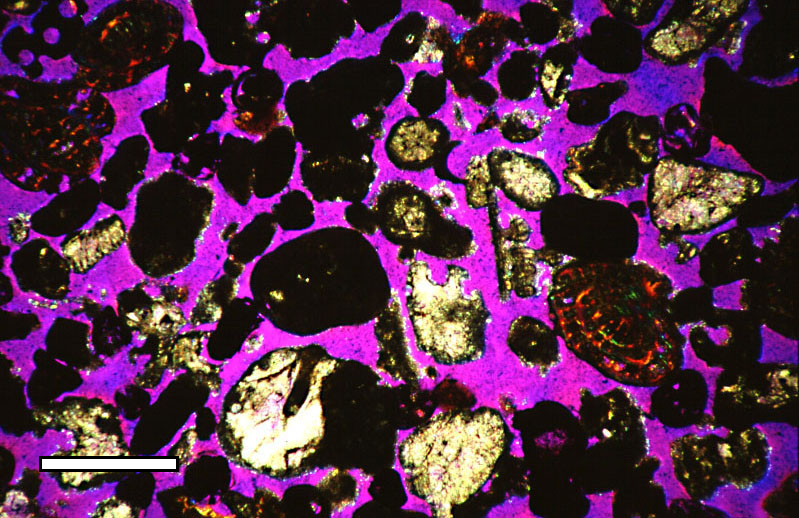
Weekly Blog 12/11 - Permeability and Porosity
 |
| https://upload.wikimedia.org/wikipedia/commons/f/ff/Porosity_thin_section_GP.jpg |
Summary
There are many different types of soil. Some soil has high porosity while some has high permeability. The porosity of soil is how many pores (spaces between soil particles) there are and how big the pores are. If there are many pores, it has high porosity. If it has less pores and a larger space between each particle, the soil has low porosity. Permeability is how easily water can flow through. When something has high porosity, it has low permeability. If there are less gaps which are small, it is harder for water to go through. It also takes more time. If the soil however has low porosity, it is more permeable since water can flow through big gaps fast and easily.
S&EP 4: Analyzing and Interpreting Data
I analyzed the data when I learned about soil porosity and permeability. I had to read and analyze a small passage about permeability and porosity. After this, I interpreted the meaning of the data when I listened to as well as contributed to our class discussion about what the two are and how it can affect people like farmers, architects, and environmentalists. After I analyzed the data, I also interpreted it when I filled out a little information about what the two are. I also analyzed an interpreted data when I filled out a table about my charity fair products carbon footprint.We had to calculate the amount of CO2 emissions were being released by the transportation of my product from where it was manufactured to San Jose.
Sunday, December 6, 2015
12/6 Soil and Dirt
 |
| https://farm9.staticflickr.com/8310/8053614949_d7a02c92c5_o_d.jpg |
Summary
Many people might not know this, but dirt and soil is actually one of our most important natural resources in the world. Soil is responsible for many things such as farming and agriculture, many major forests, providing us with a source of timer, fuel, and homes to many plants and animals. It is also a water filter, air cleaner, it can help create clothing (cotton plants), and can even hold toxic materials that we be around if not for soil. Franklin D. Roosevelt said "a nation that destroys soil destroys itself". So how is soil made? Soil is actually just weathered down bedrock. Once the bedrock mixes with other materials on the surface, soil is made.
S&EP 4: Analyzing and Interpreting Data
I analysed and interpreted data when I filled out a background research sheet about soil with my group. I had to research specific things such as what is soil, how soil is formed, what is the composition of soil, how soil is formed, and more. I also analyzed and interpreted data when my group was deciding about what case studies we should work on for next week. We had to read the information about the case studies and decide on which one would be most interesting.Monday, November 16, 2015
Safest Place in America Essay
Have you ever wondered what the safest place in America is? Well, I have an answer! Allentown, Pennsylvania. Allentown is on the east side of Pennsylvania which is on the northeast side of the United States. Also, it is the third most populous city in Pennsylvania! Allentown is the safest place in America because it is free from these three major natural disasters. Tsunamis, earthquakes, and tornadoes. Why is it you ask? Read on to find out more!
Splash! There is a tsunami! No worries, were safe in Allentown. To first understand why Allentown is safe from tsunamis, you need to know what it is, where it occurs geographically, and what conditions it forms under. Imagine this, you throw a rock into a small pond. What happens? You create ripples in the water of course! Now, imagine those ripples but 1000 x larger. That is a tsunami.
Tsunamis can be triggered by many things such as volcanic eruptions, landslides, earthquakes, and even (theoretically) asteroids and comets. However, most often tsunamis form from earthquakes at subduction zones. When 2 oceanic and continental plates collide at convergent boundaries and create subduction zones, the force is so strong that it can create tsunami waves in the ocean. Specifically, the earthquake has to be at least 7.0 on the Richter scale.
So where do they occur? Tsunamis only occur on the coast and most often occur on the west coast due to the Ring of Fire. The Ring of Fire is an area in the Pacific ocean that faces the west coast. There, lots of volcanic eruptions and earthquakes occur create tsunamis heading the direction of the west coast. Allentown is not on a coast or on the west coast. It is actually on the east side of America. Therefore, Allentown is safe from tsunamis. Here's a fun fact, did you know that tsunami is actually a Japanese word that can be translated to "harbor wave" in English?
Now to learn why Allentown is free from earthquakes. Earthquakes are when the ground shakes. They occur along plate boundaries. A convergent boundary is when two plates crash together. A divergent boundary is when two plates slide apart. Finally, a transformed boundary is when two plates slide against each other. In the U.S.A, earthquakes most often occur along the west side of the U.S.A (much like tsunamis). The west side of the U.S.A is right on the edge of the North American Plate, that means that it can hit the Pacific plate which is right beside it. When these two plates collide together, earthquakes can occur along the west coast. Allentown is again not on the west side of America or near any plate boundaries. Therefore, earthquakes cannot occur in Allentown
The final natural disaster I will be talking about is tornadoes. A tornado is a violent spiraling column of wind that descends from a thunderstorm. They can cause lots of damage. In order for a tornado to occur, they need flat land allowing the air to build up and keep spinning. Tornadoes occur most often in tornado alley, a place with very flat land. Tornado alley includes Texas, Oklahoma, and other states in that area. Pennsylvania is not in tornado alley since its land is not as flat as it needs to be. Also, in order for a tornado to form, you need a cold/dry air mass, a warm/moist air mass, falling pressure, and unsteady winds. The cold air mass comes from Canada while the warm air mass will come from the Gulf of Mexico. Even though these elements can occur in Allentown, the hills and mountains there will prevent tornadoes. That is why Allentown is free of tornadoes.
A similar article was published by the New York Times. They said that Corvallis, Oregon was the safest place in America. However, this is incorrect because of two reasons. One reason is because tsunamis can occur there because of the location of the ring of fire. As you know tsunamis occur along the west coast, where Oregon is. That is one reason why Corvallis, Oregon is not the safest place in America. The second reason why it is not the safest place is because earthquakes can occur there. Since it is again on the west coast, it is right at the boundary between the Pacific and North American Plate. This means that those two plates can collide creating earthquakes in Corvallis, Oregon. I hope you learned lots about the safest place in America... Corvallis, Oregon!
Subscribe to:
Posts (Atom)